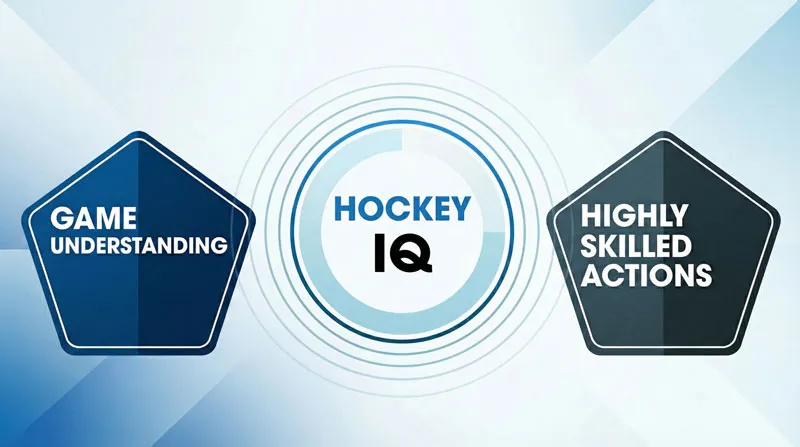
In hockey, skill and physical ability are essential, but the ability to read the game, anticipate plays, and make quick decisions under pressure is often what separates good players from great ones. This cognitive edge—commonly referred to as Hockey IQ—is a critical component of player development and a true differentiator at every level of the game.
Hockey IQ refers to a player's ability to understand the flow of the game and use that understanding to make effective decisions. It includes awareness, anticipation, vision, creativity, adaptability, and decision-making. Players with high Hockey IQ know where to be, what play is coming next, and how to react before the puck arrives. They consistently put themselves in positions to succeed, even when the game speeds up or situations become unpredictable.
Why Scouts and Coaches Prioritize Hockey IQ
As video analysis and advanced analytics become more sophisticated, scouts and coaches are increasingly focused on evaluating Hockey IQ. Decision-making, off-puck movement, situational awareness, and adaptability are now closely examined, often providing a clearer indicator of long-term success than raw skill alone. A player who can process the game quickly and consistently make smart choices is far more likely to succeed as competition increases.
As players advance from junior hockey to collegiate and professional levels, systems and structure play a larger role. Coaches want athletes who can think the game, execute within a system, and adjust without constant direction.
Breaking Down Hockey IQ
Hockey IQ can be viewed as an umbrella term, but it can also be broken down into offensive IQ, defensive IQ, and positional IQ. Offensive IQ reflects a player's ability to create and recognize scoring opportunities. Defensive IQ involves reading threats and making responsible decisions away from the puck. Positional IQ is knowing where to be within a system at all times. Players who excel in these areas elevate not only their own performance, but the performance of their entire team.
How to Develop Hockey IQ
Developing Hockey IQ requires intentional effort. Simply watching games for entertainment does little to improve on-ice intelligence. Players must actively study the game—observing systems, positional rotations, and situational play. Video review is especially valuable, enabling players to identify patterns in their play, recognize mistakes, and reinforce positive habits. Self-awareness is the first step toward improvement and enables players to translate practice habits into smarter game performance.
Developing Hockey IQ is often a bigger challenge than mastering physical skills alone. Many players focus on skating, shooting, and puck control without learning how to apply those skills in real-game situations. Without understanding when and where to use their abilities, even highly skilled players can struggle to make an impact.
Aligning Skills with Tactical Demands
Equally important is aligning individual skills with the tactical demands of hockey. A player may be fast and offensively gifted but lack a framework for decision-making, positioning, or reading the play. Developing Hockey IQ means teaching not just how to execute skills, but when to use them, how to anticipate the game, and how to integrate strengths into a team system. Without this alignment, even talented players can fall short of their potential.
Consider two players of the same age. Player A is the fastest skater on the ice, but consistently forces low-percentage plays and skates into trouble. Player B is an above-average skater but reads the play well, supports teammates, and anticipates passing lanes. In most games, Player B will have a greater impact. Speed can be taught and refined, but strong instincts and game awareness often translate more effectively to higher levels of play.
The Bottom Line
Ultimately, hockey is not just about skating fast or shooting hard—it's about thinking one step ahead. Hockey IQ transforms individual skill into meaningful impact and gives players the confidence to adapt in any situation. Players who invest in developing their Hockey IQ perform more consistently, make fewer mistakes, and often enjoy longer careers.
In today's game, being a smart player is not optional—it's essential. The players who learn to think the game put themselves in the best position to succeed, contribute, and advance at every level of hockey.